
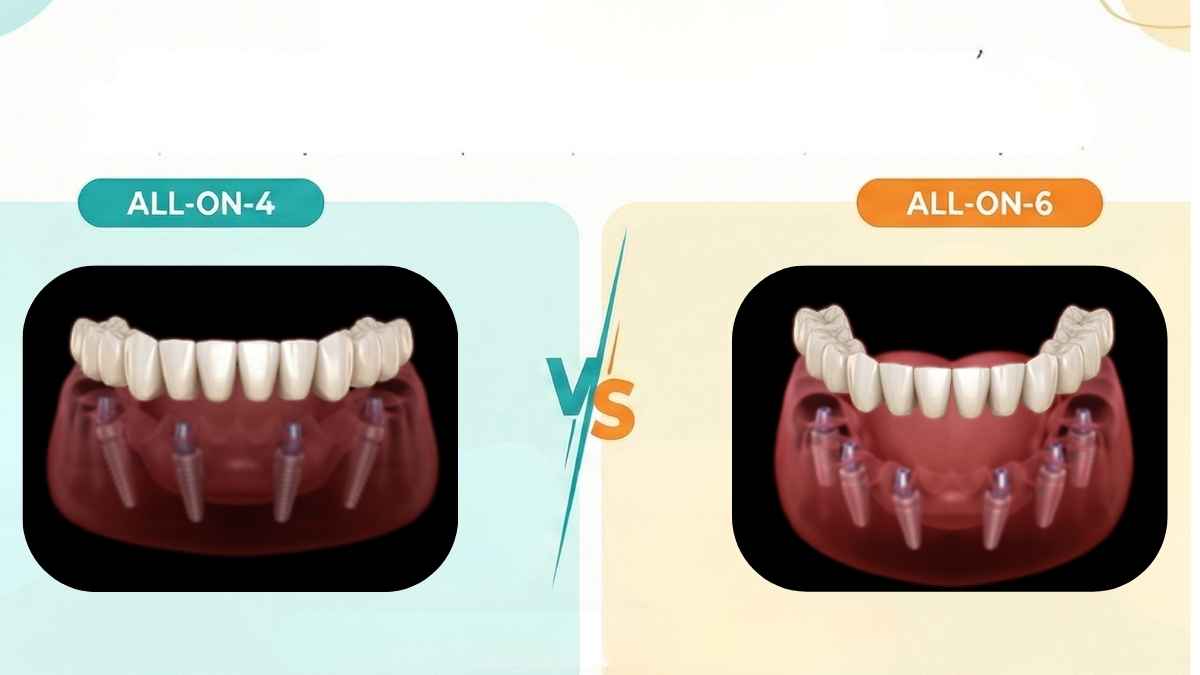
Choosing the right number of implants is the foundation of a successful full-arch transformation. While both protocols are highly effective, the decision hinges on your unique bone anatomy and functional needs
If you are evaluating all on 4 vs all on 6 treatment options, Ata Dental Center offers personalized clinical assessments to determine which approach best matches your bone density, bite force, and long-term expectations. Book a free consultation to receive a detailed treatment plan tailored to your case.
What Is All-on-4?
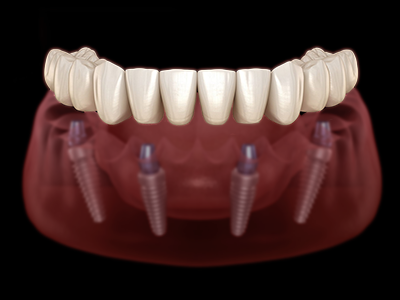
All-on-4 is a full-arch implant concept where:
- Four implants support a fixed full-arch prosthesis
- The two posterior implants are placed at an angle to maximize bone contact
- Immediate loading is often possible
- Bone grafting can frequently be avoided
- A fixed bridge restores chewing efficiency and aesthetics
This system is often discussed in all on 4 dental implants vs all on 6 comparisons because it offers lower initial cost.
When Is All-on-4 Usually Considered?
All-on-4 is typically recommended when:
- The patient has moderate bone resorption
- Bone volume is limited in the posterior region
- The patient prefers fewer implants
- Budget considerations are important
- Immediate function is desired
In many all-on-4 vs all-on-6 implants differences discussions, All-on-4 is positioned as a cost-effective option.
What Is All-on-6?
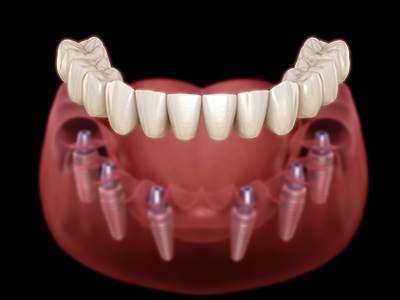
All-on-6 uses:
- Six implants distributed evenly across the jaw
- A broader support base for the prosthesis
- Improved force distribution
- Increased structural stability
- Greater redundancy if one implant fails
In all on 6 vs all on 4 evaluations, All-on-6 is often preferred for patients with stronger bite forces or higher long-term durability expectations.
For detailed technical information, you can review our all on 6 dental implant in Turkey page.
All-on-4 vs All-on-6: Key Differences
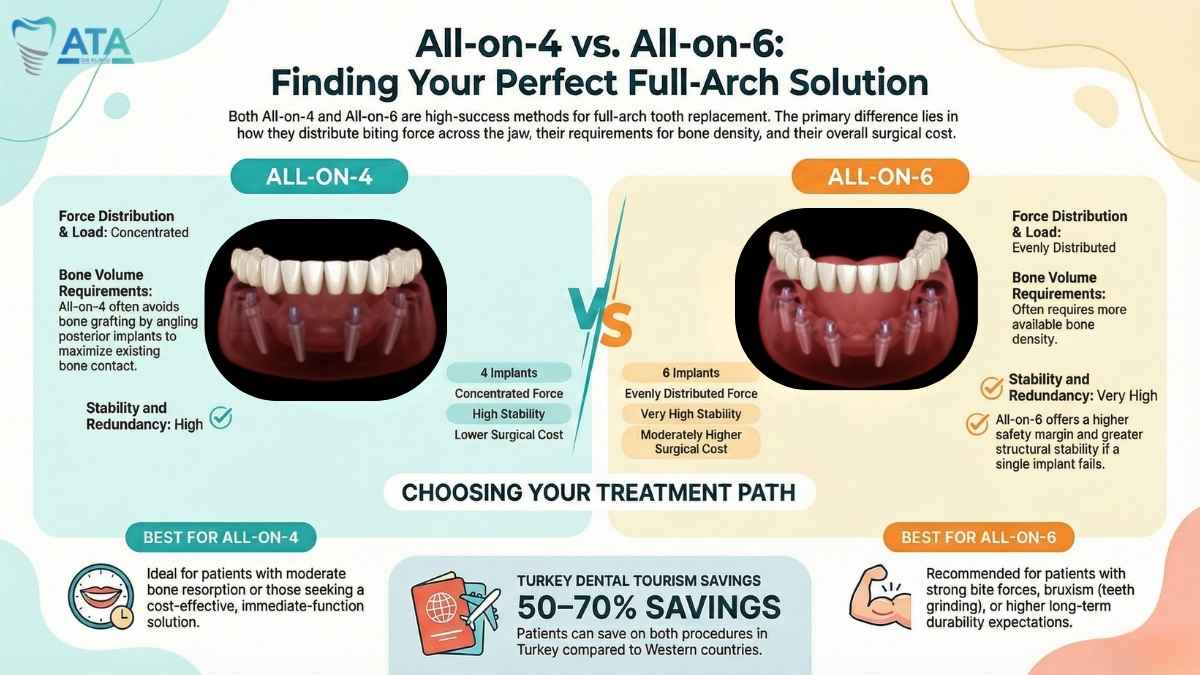
Below is a simplified all-on-4 vs all-on-6 dental implants comparison:
| Criteria | All-on-4 | All-on-6 |
|---|---|---|
| Number of Implants | 4 | 6 |
| Force Distribution | Concentrated | More evenly distributed |
| Stability | High | Very High |
| Bone Support | Moderate | Stronger anchorage |
| Long-Term Durability | Strong | Higher long-term reliability |
| Risk if One Implant Fails | Higher impact | Lower impact |
| Surgical Cost | Lower | Moderately higher |
This table highlights core all-on-4 vs all-on-6 dental implants advantages disadvantages.
Expert Insight: While All-on-4 is a marvel of modern engineering for bone efficiency , we often recommend All-on-6 for patients with a history of bruxism (teeth grinding) to ensure the longevity of the restoration under higher pressure.
Bone Density & Structural Support
One of the most important differences in all on-4 vs all on-6 dental implants is how chewing force is distributed inside the jaw.
With four implants:
- Higher load per implant
- Greater stress concentration on posterior implants
- Less redundancy if one implant fails
With six implants:
- Reduced force per implant
- Improved load distribution across the arch
- Enhanced biomechanical balance
- Greater safety margin
Long-Term Stability: Why Implant Number Matters
Over time, chewing pressure creates micro-stress at implant interfaces.
With fewer implants:
- Stress accumulates on specific points
- Wear may increase on prosthetic screws
- Bone remodeling may be more localized
With more implants:
- Forces are distributed more evenly
- Mechanical fatigue risk is reduced
- Prosthesis longevity may improve
This is why many clinicians consider All-on-6 biomechanically advantageous in all-on-4 vs all-on-6 implants differences analyses.
Cost Comparison: All-on-4 vs All-on-6
When discussing all-on-4 vs all-on-6 cost, the primary difference is the number of implants and surgical time.
In the UK and USA:
- All-on-4 can range significantly higher
- All-on-6 is typically more expensive due to additional implants
In Turkey:
- Both options are considerably more affordable
- By leveraging Turkey’s advanced dental infrastructure, patients can access premium implant materials and expert surgical care at a fraction of the cost found in the UK or USA, without compromising clinical outcomes.
This price advantage makes full-arch solutions in Turkey accessible without compromising quality.
Is All-on-6 More Successful Than All-on-4?
Clinical studies generally show high success rates for both concepts. However:
- All-on-6 may offer enhanced long-term biomechanical stability
- It provides better load distribution
- It reduces risk in case of single implant failure
In many all on 4 dental implants vs all on 6 discussions, All-on-6 is recommended for patients with strong bite force or bruxism. That said, final decisions must always be made after individualized evaluation.
Which Option Feels More Natural?
Both systems use fixed prostheses. However:
- All-on-6 may feel slightly more stable under heavy chewing
- Patients with higher bite pressure often report increased confidence
Comfort perception depends on bone quality, prosthesis design, and occlusal planning.
Maintenance & Hygiene
Both systems require:
- Daily brushing with specialized tools
- Regular professional cleaning
- Annual radiographic monitoring
Maintenance difficulty is similar in all-on-4 vs all-on-6 dental implants comparison contexts.
Risk Factors That Influence the Decision
Certain clinical factors affect implant planning:
- Bruxism
- Smoking
- Diabetes
- Severe bone resorption
- Poor oral hygiene habits
These factors are critical in determining whether all on 4 vs all on 6 dental implants is more suitable.
Can All-on-4 Be Upgraded to All-on-6 Later?
Technically, yes. However:
- Additional surgery is required
- New implants must be integrated
- Prosthesis modification or replacement may be needed
- Treatment cost increases
For this reason, choosing the correct protocol initially is very important.

Our Clinical Approach at Ata Dental Center
When evaluating all on 4 vs all on 6, our priority is:
- Detailed CBCT bone analysis
- Bite force evaluation
- Long-term structural planning
- Patient-specific risk assessment
- Transparent explanation of pros and cons
We do not recommend a protocol solely based on cost. Instead, we determine what provides the best long-term function and structural reliability.
All on 4 Dental Implant vs All on 6 Dental Implants: Which Should You Choose?
Choosing between All-on-4 and All-on-6 is not simply about the number of implants.
It is about:
- Bone density
- Bite strength
- Long-term durability expectations
- Risk tolerance
- Budget planning
- Overall oral health
Ata Dental Center has been serving patients in the same Istanbul location since 2001, maintaining consistent clinical standards and standing behind every treatment we provide. International patients benefit from organized planning, VIP airport transfers, comfortable accommodation options, and the opportunity to combine treatment with a dental holiday Turkey experience.
If you are comparing all-on-4 vs all-on-6 dental implants advantages disadvantages, our team will guide you through a comprehensive evaluation to determine which solution ensures long-term success for your smile.